Pattern Design
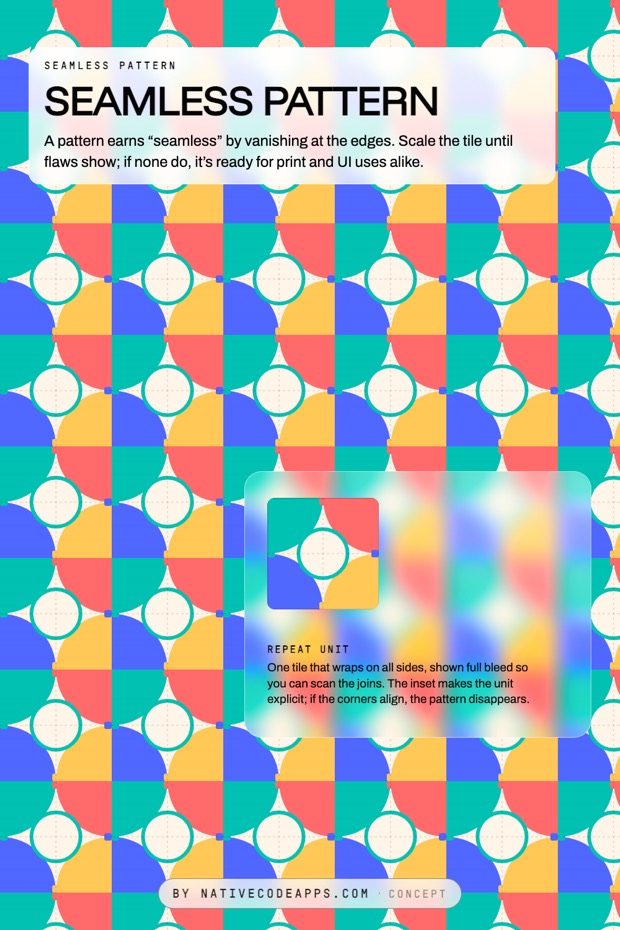
Seamless tiles and repeat units, shown full bleed with the repeat made explicit. Built for print and screen alike.
How this is done
The repeat has to disappear
A pattern is finished when you cannot find the edge of the tile. Tile it large and stand back. If your eye lands on the same spot every time, the tile is telling you where it ends and the work is not done.
- Build on a square grid first. Diagonal motion is easier to add later than to fix.
- Carry every shape that touches an edge across to the opposite one, exactly.
- Tile it at least six across and six down. Faults hide at two by two.
- Squint at it. Clusters and holes show up as light and dark patches before they show up as shapes.
- Check it at the smallest size it will ever print. Detail that muddies at two inches is detail to cut.
Try it
The same room, four surfaces
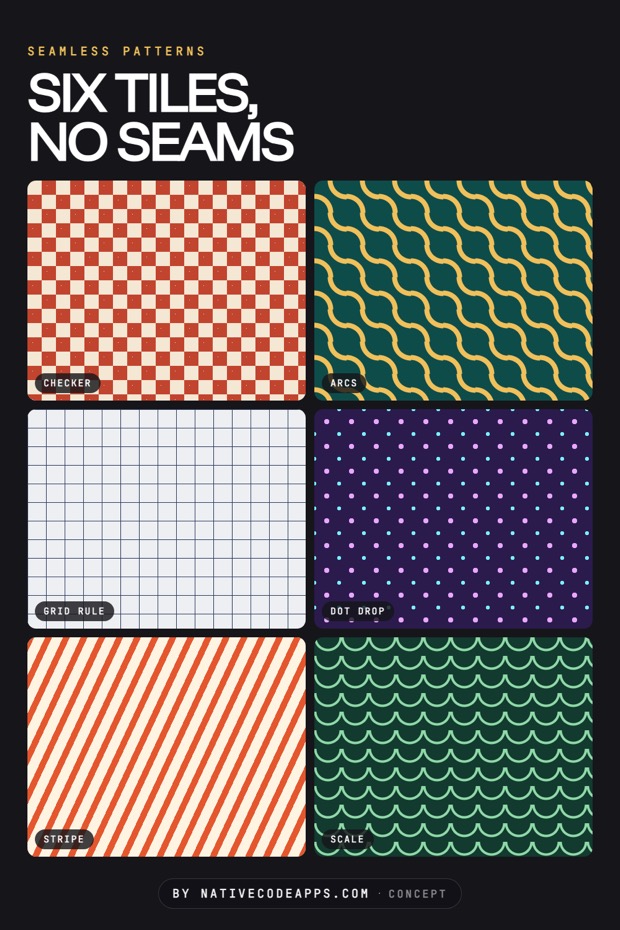
One product, four ways of drawing the thing on the wall. Each one costs a different amount to print and hides its repeat differently.
Reno, Nevada
Wallpaper printed to order
Rolls cut to your wall, printed in Nevada, with the repeat matched at every seam.
Order a sampleOchre bowl$48
Sage vase$62
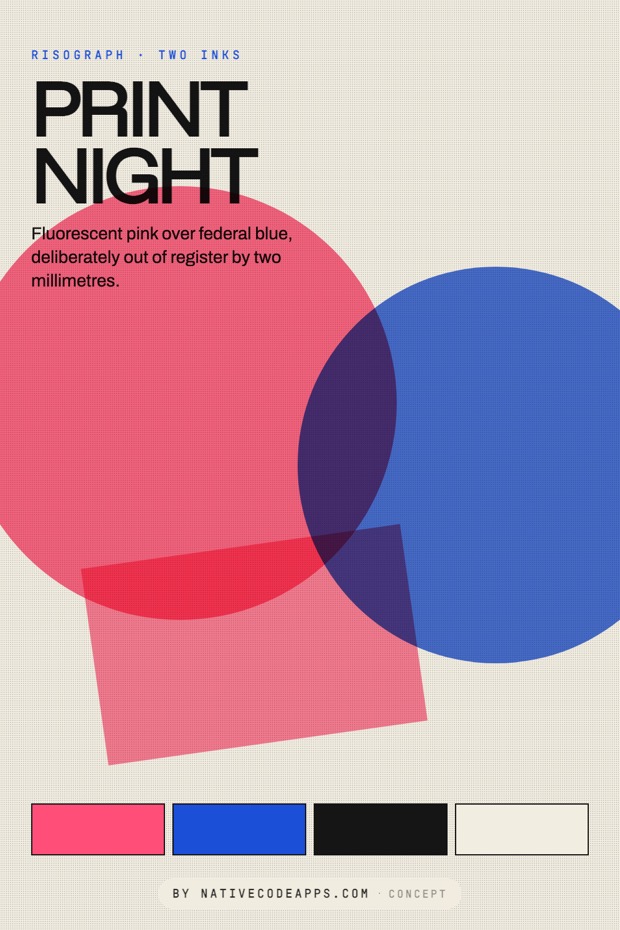
Slightly off register, ink pooling at the edges. The imperfection is the product, and it has to be drawn deliberately or it reads as a mistake.
Hard edges on a strict grid. Easiest to tile, hardest to make interesting, and the safest choice for a room somebody has to live in.
Organic shapes with no visible grid at all. It hides the repeat well and takes three times as long to draw.
One ink, tone carried by density alone. Cheapest to print by a wide margin, and it never argues with the furniture.
It depends
The same rule, four projects
None of the above survives contact with a real brief unchanged. Here is where the decision moves, and what moves it.
Wrapping paper
Scale up. A pattern read at arm length can carry far more detail than a screen one.
A website background
Hold it back until it is nearly invisible. It is behind words, and words win.
A small label
One motif, large. A busy tile at two inches turns into texture and stops being a pattern.
Textile
Test it on a curve. Everything reads differently once the surface stops being flat.
The set
The set
Elsewhere
If one of these is close
Working on something and unsure which way to take it? Tell us which of these you keep coming back to and we will work it up against your actual brief. Most projects start as somebody pointing at two directions and saying the truth is somewhere between them. That is a good way to start.
New pieces go up on the Pattern Design board on Pinterest before they land here. The other sets sit on the design index, and what we build with all of it is what we do.